Outer Banks septic guide
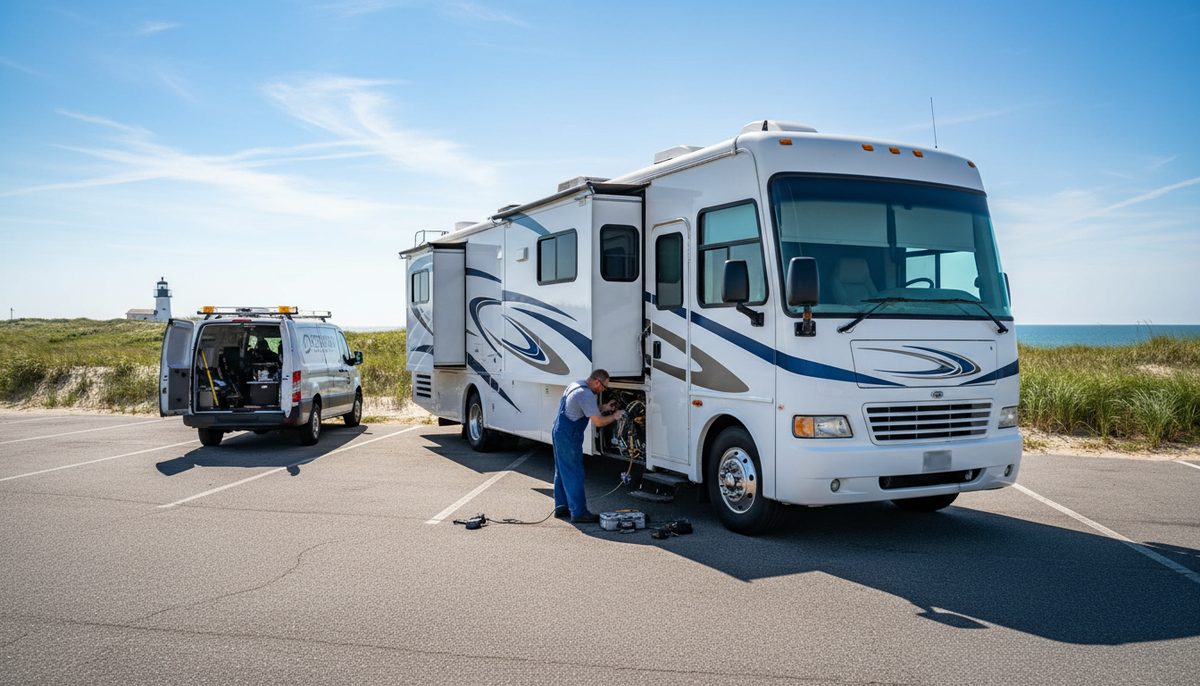
RV air conditioner repair on the Outer Banks
Most RV air conditioning failures on this coast are power problems, not compressor problems. Voltage sag, capacitors, coils packed with salt and sand, and what actually needs replacing.
Before anybody condemns a rooftop unit, the question to answer is whether it is being given enough electricity to work with. A roof air conditioner is the largest electrical load in most recreational vehicles by a wide margin, and the overwhelming majority of midsummer no-cooling calls on this beach turn out to be a supply problem, a starting problem, or a filthy-coil problem rather than a dead compressor.
The details
Voltage is the first suspect and the one most owners never check. A compressor asks for a large inrush at the instant it starts, and if the voltage at the rig sags far enough during that moment the motor stalls, draws locked-rotor current, and trips out — sometimes immediately, sometimes after it has cooked the windings over several summers. Long extension leads, tired campground pedestals, and a park at full occupancy on the hottest afternoon of the year all produce exactly this. A cheap plug-in voltage monitor at the inlet turns an invisible failure mode into a number you can see.
The starting components are next and they are the most commonly replaced part on any rooftop unit. A run capacitor that has drifted out of tolerance will let a unit hum, click and trip without ever spinning up, and the symptom looks identical to a seized compressor from the passenger seat. Testing one takes a meter and a minute. Guessing costs a rooftop unit, which is why a competent diagnosis pays for itself here more clearly than almost anywhere else on the rig.
Then the coil, and this is where the Outer Banks is genuinely harder on equipment than an inland park. The condenser coil sits in the open on the roof, breathing salt-laden air all season, and the fins load up with a paste of salt and fine sand that insulates exactly the surface that is supposed to be shedding heat. A unit with a packed coil will run continuously, cool poorly, and eventually trip on high head pressure — and it will do all of that with a perfectly healthy compressor. Gentle cleaning on a schedule is the highest-value maintenance item on this coast.
Airflow inside the coach is the mirror image of the same problem. A blocked return filter, a closed-off duct run, or a ceiling assembly full of the dust of two seasons will starve the evaporator and can ice it solid, at which point the vents blow warm air while the unit runs flat out. If the cold has faded gradually rather than failed suddenly, look at the filter before you look at anything expensive.
Expectations are worth setting honestly too. These units are sized to pull the interior temperature down by a limited margin against the outside air, not to hold a fixed setpoint against a July afternoon with the sun on a dark roof. Shade, closed blinds, a vent fan moving the hot layer out, and not opening the door every ten minutes do more on the worst day than any repair will. Two units in a long coach are two separate systems, and one of them failing is a much smaller job than owners fear.
The local wrinkle is where you can plug in at all. Shore power on this seashore means 47 sites with electricity and water at Oregon Inlet and nowhere else, so most rigs here are asking a generator or an inverter to run the air conditioning, and both of those introduce their own voltage and starting problems. Across four NPS campgrounds, all take RVs the wired inventory is a few dozen pads, which is why so many air conditioning calls out here are really power calls — and why a mobile visit that starts with a meter at the inlet rather than a screwdriver on the roof gets to the answer faster. Length is irrelevant to any of this, incidentally: a van and a coach at 45 feet have the same rooftop unit and the same failure list.
Check the supply, test the capacitor, clean the coil, change the filter — in that order. The compressor is the last thing to suspect and almost never the thing at fault.
On the record: 47 sites with electricity and water (NPS — Campgrounds, Cape Hatteras (nps.gov) (retrieved 2026-09-17)) · 45 feet (N.C. General Statutes § 20-116 — Size of vehicles and loads (ncleg.gov) (retrieved 2026-09-17)) · four NPS campgrounds, all take RVs (NPS — Campgrounds, Cape Hatteras National Seashore (nps.gov) (retrieved 2026-09-17))
Hand-verified 2026-09-17 against the primary sources named above; where a fact could not be verified it was left out, never guessed.