Outer Banks septic guide
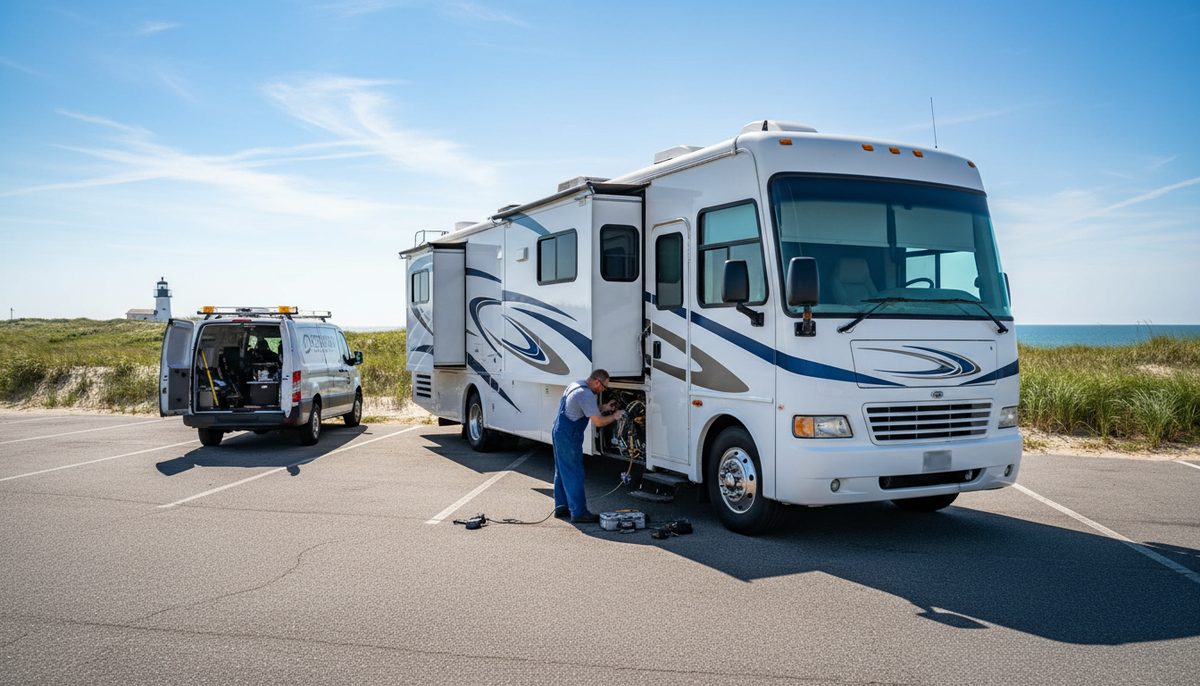
RV slide-out repair on the Outer Banks
Slide-outs fail by mechanism type — rack and pinion, cable, hydraulic, Schwintek — and identifying yours is the first step. Plus the manual override that saves a holiday.
The first useful question is not what is wrong with the slide. It is which kind of slide it is. Four mechanisms are common in rigs on this beach, they fail in different ways, they are diagnosed with different tools, and an owner who can name theirs on the phone gets a far more accurate answer than one who cannot. Find the mechanism under the room or on the sidewall before you call anybody.
The details
Rack-and-pinion slides run a toothed rail driven by a gearbox, usually under the floor of the room. They are robust and their classic failure is a motor or gearbox that has been asked to push through an obstruction — a jammed seal, grit in the track, a room that has shifted out of square. They often sound like the problem before they become it: a change in pitch under load is the warning most people ignore.
Cable slides pull and push the room on synchronised cables, and they are the mechanism most sensitive to adjustment. Cables stretch, tension goes out of balance, and the room starts coming in or out skewed — which is not a cosmetic issue, because a skewed room will not seal and eventually damages its own guides. Cable slides that are caught early are an adjustment job; cable slides that were run skewed for a season are not.
Hydraulic slides are found on larger and heavier rooms and they fail like any hydraulic system: fluid level, a leaking cylinder, a failed pump or solenoid, and air in the circuit. They are the least likely to be a do-it-yourself diagnosis and the most likely to make an obvious mess when something lets go, which is at least a form of honesty.
Schwintek and similar in-wall systems run vertical tracks on each side of the opening and are synchronised electronically. Their characteristic fault is one side losing sync with the other, and the room binds at an angle. They are particularly sensitive to voltage, which means a slide that will not run should always be checked against battery state before the mechanism is blamed. A low house battery produces a dead-looking slide with nothing wrong in the wall at all.
Whichever it is, learn where the manual override lives before you need it. Almost every slide mechanism has one — a crank, a release, a bypass valve — and knowing where yours is turns a stranded rig into an inconvenient one. If a room will not come in and you are due to move, the override is what lets you travel; a slide left out is not a rig that can be driven. On a long coach up to 45 feet the room overhangs enough to matter, and that is true whichever of the statutory RV definition, five types you happen to own — a fifth-wheel travel trailer and a motor home run the same mechanisms.
The coastal factor here is grit. Sand in a slide track and salt in a seal are what turns an easy ten-year mechanism into a five-year one, and the maintenance that prevents it is genuinely trivial: keep the tracks clean, keep the seals conditioned, and run the room fully in and fully out occasionally rather than leaving it parked in one position for a whole season. Owners staying across four NPS campgrounds, all take RVs are cycling a slide twice a fortnight anyway, which is about right.
Name the mechanism, check the battery voltage, find the manual override. Those three steps sort the difference between a roadside inconvenience and a holiday that ends early.
On the record: 45 feet (N.C. General Statutes § 20-116 — Size of vehicles and loads (ncleg.gov) (retrieved 2026-09-17)) · four NPS campgrounds, all take RVs (NPS — Campgrounds, Cape Hatteras National Seashore (nps.gov) (retrieved 2026-09-17)) · statutory RV definition, five types (N.C. General Statutes § 20-4.01(32b) (ncleg.gov) (retrieved 2026-09-17))
Hand-verified 2026-09-17 against the primary sources named above; where a fact could not be verified it was left out, never guessed.