Pricing guide
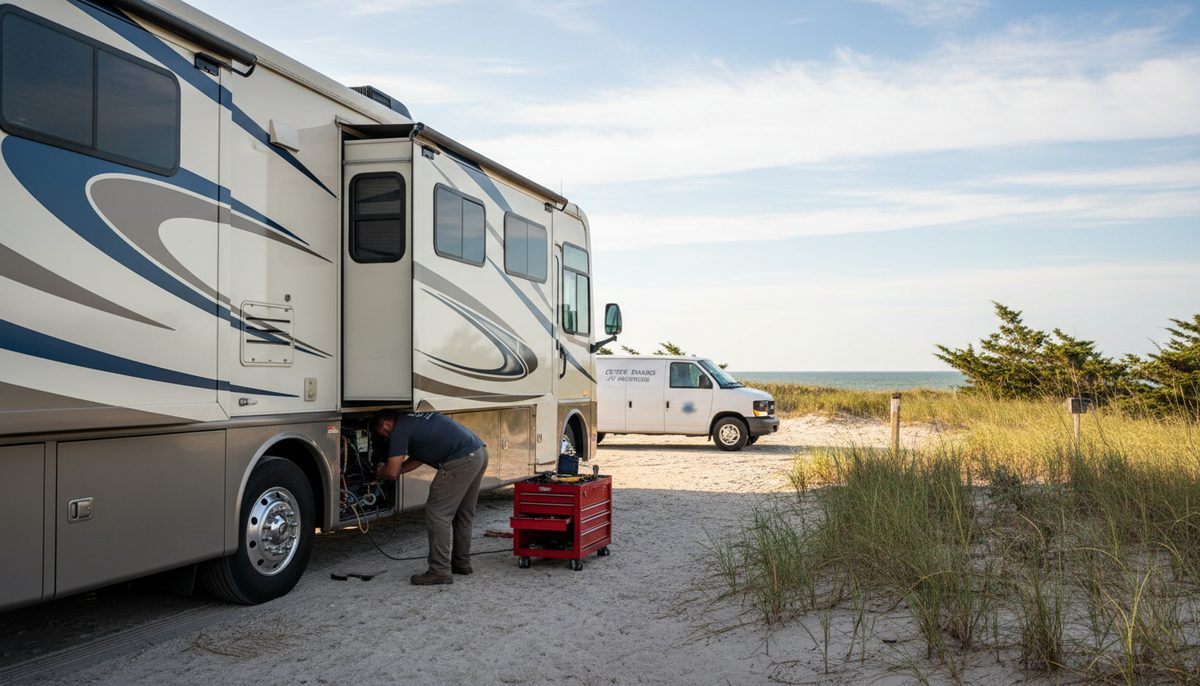
What the Ocracoke ferry costs an RV
NCDOT prices the Ocracoke toll ferries by measured length: $15 under 20 feet, $30 for 20 to 40, $45 for 40 to 65. Which bracket a coach and tow falls into, and which crossing is free.
The fare is a bracket, and the bracket is a tape measure
Nothing about the Ocracoke fare depends on what you are driving. It does not matter whether the rig is a Class A diesel coach, a fifth-wheel behind a dually, or a van conversion with a bicycle rack — NCDOT prices the crossing on one input, the overall length of the vehicle and anything coupled to it, and reads that length off a published table. On the Cedar Island and Swan Quarter crossings the top bracket is written as Ocracoke toll ferry $45 for 40–65 ft one way, with anything under twenty feet at $15 and the twenty-to-forty band at $30. Three brackets, three numbers, no negotiation at the tollbooth.
What trips people up is the word 'overall'. The bracket is set by the whole thing you drive onto the deck, not by the unit that has the engine in it. A thirty-two-foot motorhome towing a car on a dolly is not a thirty-two-foot vehicle for fare purposes; it is whatever the pair measures bumper to bumper, and that arithmetic moves a great many rigs from the $30 band into the $45 one. Measure it once at home, write the number on the inside of a cabinet door, and stop guessing at the ticket window.
Which crossing you choose decides whether you pay anything at all
Before optimising the bracket, look at the route. Ocracoke has more than one way in, and they are not priced alike: the Hatteras–Ocracoke free crossing carries no fare whatsoever, for any length, while the tolls apply only to the long mainland runs from Cedar Island and Swan Quarter and to the passenger-only express. A family coming south down NC-12 from Nags Head therefore reaches the island for nothing, and a family coming up from the mainland pays the table.
That asymmetry is worth planning around rather than accepting. If your route to the Outer Banks is flexible, entering the island chain from the north and running the length of Hatteras Island puts the free crossing at the end of the drive. If you are coming from the south and the Cedar Island run genuinely saves you hours, the $45 is a reasonable price for those hours — but it should be a decision you made, not a fare you discovered.
What NCDOT actually says about size
The fear behind most of these searches is not the money. It is the suspicion that a big coach will be turned away at the ramp. NCDOT answers that directly: the ferries accommodate motorcycles and any highway-legal RV — any car, trailer or recreational vehicle that can lawfully be operated on the highway — and vehicles longer than sixty-five feet are handled by special permit rather than by refusal.
Read the condition in that sentence carefully, because it is the whole rule. The ferry's size test is the highway's size test. If the rig is legal on the road that brought it to the terminal, the deck will take it; if it is not, the ferry is not the place to discover that. The permit path above sixty-five feet exists for genuine outliers — a long combination, an oversize load — and it is arranged in advance, not at the dock on a Saturday morning in July.
The system the fare belongs to
It helps to know that these boats are a highway rather than an excursion. NCDOT runs seven routes, more than 20 vessels, sailing every day weather permitting and connecting Hatteras Island, Ocracoke Island, Southport, Currituck and Swan Quarter. The Ocracoke runs are two of those seven, and the fare table is a state transportation schedule, not a tourist attraction's pricing.
The practical consequence is that the fare is stable and the schedule is not. Weather cancels sailings on this coast with no notice worth relying on, and a full deck on a summer afternoon turns a scheduled departure into the next one. Build the slack into the day rather than into the budget — the $45 is the predictable part of this crossing and the departure time is not.
The number that sets your bracket is the number that sets your legality
Here is the part almost nobody connects, and it is the reason this page lives on a repair site rather than a travel one. The measurement that decides your fare bracket is the same measurement North Carolina uses to decide whether the rig belongs on the road. A recreational vehicle is capped at 45 feet, excluding bumpers and mirrors, and any combination of vehicles coupled together is capped at 60 feet, two units. A coach plus a towed car is a combination, and the sixty-foot ceiling binds it.
So a rig sitting comfortably inside the top ferry bracket at, say, sixty-two feet overall is already past the statutory combination limit before it ever reaches the terminal. The fare table will happily take your money; the statute will not care that it did. If your measured length is anywhere near sixty feet, the question to settle is not which bracket you are in but whether the combination is lawful — and that is a question to answer in a driveway, with a tape, before a holiday is built on the wrong assumption.
Budgeting the island rather than the boat
The fare is the smallest line in an Ocracoke trip and it is the one everybody researches. The larger one is where the rig sleeps. Ocracoke Campground, inside the national seashore, runs 136 sites, $28, year round a night and is open year round — and it has no utility connections at all, which means every night on the island is a night on batteries and propane rather than on shore power. Two nights and a round trip on the tolled route is a real number; two nights and the free crossing is a much smaller one.
Book the site before you book the boat. Reservations for the seashore campgrounds are recreation.gov only, rangers cannot take payment on site, and the island's inventory is finite in a way the ferry's is not. A crossing you missed costs you an afternoon; a campsite you did not reserve costs you the trip.
What to have settled before you drive to the terminal
Four things, none of which take long. Your measured overall length, including whatever is hitched behind you. Which crossing you are taking and therefore whether a fare applies. A reservation on the island for every night you intend to be there. And an honest assessment of whether the rig is ready to sit on an island with one road on and off it — because a house-battery fault, a slide that will not retract or a fridge that quits on propane is a different problem in Ocracoke village than it is in Kill Devil Hills.
That last point is the one we exist for. Mobile work on this beach is scheduled around ferry departures and the length of NC-12, and the repairs that go smoothly are the ones called in before the crossing rather than after it. If something on the rig has been marginal all season, the week before an island trip is the week to deal with it.
Measure the rig, pick the crossing, reserve the site, and make the call about anything that has been nearly-failing since spring. The fare is published and predictable; everything expensive about an Ocracoke trip is the part people did not check first.
On the record: Ocracoke toll ferry $45 for 40–65 ft (NCDOT Ferry Division — Ticket Prices (ncdot.gov) (retrieved 2026-09-17)) · any highway-legal RV (NCDOT Ferry Division — Ride with Us (ncdot.gov) (retrieved 2026-09-17)) · Hatteras–Ocracoke free (NCDOT Ferry Division — Ticket Prices (ncdot.gov) (retrieved 2026-09-17)) · seven routes, more than 20 vessels (NCDOT Ferry Division — Ride with Us (ncdot.gov) (retrieved 2026-09-17))
Hand-verified 2026-09-17 against the primary sources named above; where a fact could not be verified it was left out, never guessed.