Outer Banks septic guide
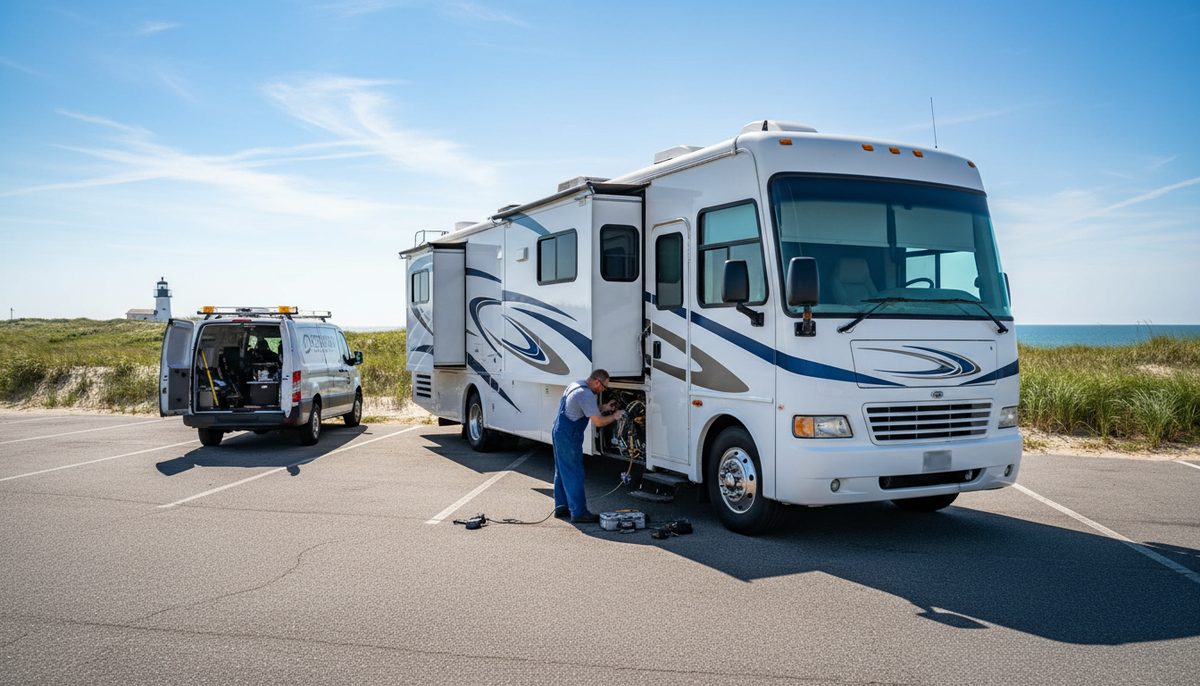
RV roof leak repair on the Outer Banks
An RV roof leak is a sealant maintenance failure with a deadline. Where water actually gets in, how delamination happens, and the seam inspection schedule this coast requires.
Water almost never comes through the middle of an RV roof. It comes in at the edges of things — around the air conditioner, the vents, the antenna, the skylight, the refrigerator vent, and along the seam where the roof membrane meets the front and rear caps. Every one of those is a hole cut in the roof and then sealed, and it is the sealant rather than the roof that has the short life.
The details
That is why roof leaks are a maintenance failure rather than an accident. Lap sealant and self-levelling compound are consumables with a service life measured in a few years, and they age faster under ultraviolet light and thermal cycling than any brochure suggests. The rig did not fail; the sealant reached the end of its life and nobody looked. On this coast, with unobstructed sun, wind-driven rain and salt, the interval is at the short end of the range rather than the long one.
The damage model is what makes this urgent rather than annoying. Water entering at a roof penetration does not drip neatly into the middle of the floor where you would see it. It runs along the inside of the roof structure, soaks into the laminated wall panels, and separates the layers from the inside out. By the time a stain appears on a ceiling panel or a wall develops a soft bulge, the water has been there for months and the repair has moved from a tube of sealant to a structural job.
Membrane type changes the repair and it is worth knowing which you have. EPDM rubber roofs are the most common and are repaired with compatible lap sealant and EPDM patch material; TPO looks similar and takes different products; fibreglass roofs are a different job again. Using the wrong product on the wrong membrane produces a repair that looks fine for one season and lifts in the next, which is the single most common thing we are called to redo.
The inspection itself is straightforward and belongs on a calendar. Twice a year at minimum, and after any serious weather, get up there safely and look at every seam and every penetration: cracks, chalking, lifting edges, gaps at the corners of vent flanges. Sealant that has gone hard and crazed is at the end of its life even if nothing has leaked yet. This is the part that is cheap — the tube is cheap, the hour is cheap, and it is the only stage at which the whole problem is cheap.
There is also a diagnostic trap worth naming. Not every interior water stain is a roof leak. Window frames, marker lights, the awning rail, sidewall seams and the entry door are all common entry points, and water travels far enough inside a wall that the visible damage is often a long way from the actual hole. A proper diagnosis finds the entry point rather than sealing the nearest suspicious thing, which is why hosing the rig down section by section with somebody inside watching is a genuinely useful technique.
For rigs living on this seashore the exposure is at the high end. Salt accelerates the corrosion of every fastener under those flanges, wind-driven rain finds gaps that vertical rain never would, and a rig parked across four NPS campgrounds, all take RVs for a season is outdoors for every hour of it. That applies equally to each of the statutory RV definition, five types — a truck camper's seams age the same way a coach's do — and the length of the thing, up to the lawful 45 feet, only changes how many penetrations there are to check.
Inspect the seams twice a year, use the product that matches your membrane, and treat any interior stain as a search for an entry point rather than a spot to patch. Delamination is the expensive ending to a cheap problem ignored.
On the record: four NPS campgrounds, all take RVs (NPS — Campgrounds, Cape Hatteras National Seashore (nps.gov) (retrieved 2026-09-17)) · 45 feet (N.C. General Statutes § 20-116 — Size of vehicles and loads (ncleg.gov) (retrieved 2026-09-17)) · statutory RV definition, five types (N.C. General Statutes § 20-4.01(32b) (ncleg.gov) (retrieved 2026-09-17))
Hand-verified 2026-09-17 against the primary sources named above; where a fact could not be verified it was left out, never guessed.